Wednesday, April 30, 2014

Conclusion

 Brown v. Board of Education contributed to the desegregation. If Reverend Brown are alive today, he may be glad his claim to influence education for  his offspring, also, he may be sorry about their propose which did not come true. There are some distances between white and black until today.
       The desegregation of education offered black students a good environment to study and grow up. One the one hand, it controlled and cured children’s inferiority. On the other hand, it boost integration of two races and developed the relationship of black and white. However, although the desegregation affects racial discrimination more positive, what it left undone cause problems also. Re-segregation can not happen again. Therefore, I believe the desegregation did not completely successful. 

Impact of Desegregation

       Finally, the desegregation of school did influence many aspects, including Acts from government, and how black students were treated equally or not. Here is my thought.    
    First at all, because this case caused by unequally civil rights, and caused black children inferiority of race, it bought some Acts for protecting civil right. “ Brown v. Board of Education encourage[d] to further the civil rights work of the 1960s, which in turn led to the Civil Rights Acts(1964,1991), the Voting Rights Act (1965), the Fair Housing Act (1968) and related legislation” ( Zirkel and Cantor 4). Those action from government helped to change racial discrimination between black and white, and keep black’s social role in the United States.         

 Second, government pushed desegregation in school harshly, and it did make progress of treating black students. “After desegregation's first decade, only 2.3 percent of African American children in the Deep South attended integrated schools” and “In 1966, the Fifth Circuit Court, in United States v. Jefferson County Board of Education, ordered school districts not only to end segregation but to "undo the harm" segregation had caused by racially balancing their schools under federal guidelines” (School Desegregation and Equal Educational Opportunity). Black students were allowed into the common school. They really got protection constitutional this time and it was good for them growing up under a heathy circumstance.       However, had desegregation ended their tragedies yet? It was still a consideration about black students’ lives in the desegregate school. There was a data to show what happened to late nineteenth century. “ In 1968, it had been only 22% black students; in 1980, there were 38% African American children” ( Patterson 9). Evidently, desegregation increased rates of black students in white school or common school. It helped black students out, and improved the relationship of races. In fact, “ by 1996, this number had dropped to 32%; in 1996, the percentage of black kids in schools that are 90% or more black - which really mean[ed] they’re black schools. What’s happening was a process of creeping resegregation” (Patterson 11). This data was kind of sad to desegregation, but it really meant something. Although the desegregation was successful in some ways, it existed something undone.        Now, history was kind preparing to repeat himself. “ Today, the percentage of black students in the South that attend white majority public schools has declined to around 30. Many blacks are living in the Northern industrial cities” (“ Brown v. Board of Education). In the United States, white and black achieve not completely achieve integration. 

(Westchester, a county in New York)


Sources:
Patterson, James T. Brown v. Board of Education: Its Impact on Education, and What It Left Undone. Washington, D.C.: Woodrow Wilson International Center for Scholars, 2002. Print.
Zirkel, Sabrina, and Nancy Cantor. "50 Years After Brown v. Board of Education: The Promise and Challenge of Multicultural Education." Journal of Social Issues 60.1 (2004): 1-15. Print.
"School Desegregation and Equal Educational Opportunity." The Leadership Conference on Civil and Human Rights. N.p., n.d. Web. 29 April. 2014.


Monday, April 28, 2014

Brown v. Board of Education


   “ On May 17, 1954, the Supreme Court of the United States announced its unanimous decision that the segregation of public schools by law was unconstitutional and would no longer be allowed in this country” (Dudley 5 ). This was a marketable decision in the American history as meaningful as a milestone. One of the most important events influenced the decision was Brown v. Board of Education.        Brown v. Board of Education was based on separate but not equal. According to Dudley, “ it took place in Topeka, Kansas. In the summer of 1950, an eight-year-old girl, Linda Carol Brown, walked about seven blocks with her father, Reverend Oliver Brown, to go to the Sumner Elementary School. However, at the time. Topeka was one of the several cities on Kansas where elementary schools were separated so that Blacks, Native Americans, and other minorities were not allowed to attend classes with white children. When Reverend Brown met the principle of the Sumner and had turned his request to register, he was angry for the school policy which the Sumner Elementary School was open to white students only, because he knew Linda played amicably with white children, Native American and Hispanic children as well who lived nearby” (Dudley 7-8). 


       “ Many blacks family wanted to end segregation including the Browns in Topeka, so they sought the help of the National Association for Advancement of Colored People (NAACP). Although they struggle to change this situation by collecting votes, it was still too hard to change anything under the circumstance on the Election Day. The only way was going to the court. Before they went to the court, Reverend Brown was chosen to be the candidate. When he agreed to head of plaintiffs Topeka’s segregated schools, he said ‘ [my daughter] seem[ed] very apt. I want[ed] her to have something more to look forward to then washing dished.’ Also, he was tired to be treated as a second-class citizen. Therefore, the battle began” (Dudley 8-9). 
        However, “On February 28, 1951, Brown v. Board of Education was filed in Federal district court, in Kansas" (Timeline of Events Leading to the Brown v. Board of Education Decision, 1954) “ When Reverend Brown as a representative-plaintiff claimed that Topeka's racial segregation violated the Constitution's Equal Protection Clause because the city's black and white schools were not equal to each other and never could be, the federal district court dismissed his claim, and ruling that the segregated public schools were "substantially" equal enough to be constitutional under the Plessy doctrine which held that segregated public facilities were constitutional so long as the black and white facilities were equal to each other” ( McBride). 
       Moreover, Reverend Brown did not give up. “ He asked all separated schools together and appealed to the Supreme Court. Thurgood Marshall was the chief counsel for the plaintiffs. Earl Warren was the leadership of Chief Justice” ( McBride). 
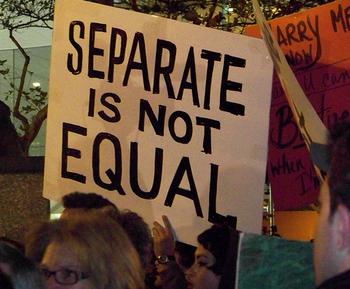
  
   As the result, “ on May 17, 1954, the Court overturned Plessy v. Ferguson, and declared that racial segregation in public schools violated the Equal Protection clause of the 14th Amendment” (Timeline of Events Leading to the Brown v. Board of Education Decision, 1954). In Marshall’s speaking, he said that racial segregation of children in public schools violated the Equal Protection Clause of the Fourteenth Amendment, which states that "no state shall make or enforce any law which shall ... deny to any person within its jurisdiction the equal protection of the laws” (McBride). Also, “ the Court concluded that racial segregation in school did not offer equal education to black children which was a promise, and although the public facilities were equal between black and white schools, racial segregation in school [was] ‘inherently unequal’and thus that was unconstitutional” (McBride
       “ On May 31th, 1955, the Supreme Court declared Brown II which was intended to work out the mechanics of desegregation, and made the desegregation in schools happen with ‘all deliberate speed’ in the whole United States” (Timeline of Events Leading to the Brown v. Board of Education Decision, 1954).
       Brown v. Board of Education in Topeka was super meaningful for the desegregation of education in the United States, especially for black students. The decision might change their future. 


Sources:
Dudley, Mark E. Brown v. Board of Education (1954): School Desegregation. New York: Twenty-First Century, 1994. Print.   
"Brown v. Board of Education Timeline." National Archives and Records Administration. National Archives and Records Administration, n.d. Web. 29 Apr. 2014.
McBride, Alex. "Brown v. Board of Education (1954)." PBS. PBS, n.d. Web. 29 April. 2014.

Desegregation and Segregation

           In the dictionary, desegregation means “the elimination of laws, customs, or practics under which different races, groups and are restricted to specific or separate public facilities, neighborhoods, schools and organizations” (dictionary) In the American history, the target of the restriction and separated was black, but they seek and struggle for desegregation for a long time. . 
       Desegregation based on refusing segregation and against unequal treating. After Lincoln abolished slavery, there were three Constitution Amendment passed which was Thirteenth, Fourteenth, and Fifteenth to protect the blacks’s rights and give their freedom back. But after Lincoln’s death, the blacks’ rights were a big events in the Reconstruction. Many politicians and supremacists thought the blacks were free already and they did enough. Also, most of blacks were illiterate and they did not ask the rights, so many whites debated that blacks did not need those rights. However, if the blacks did not have any documents to protect and could not accept any education, how could they make living by themselves? The whites were selfish and ambitious to control other races under their feet. 
       Eventually, blacks got their rights which they deserved, and they got equality constitutionally. Racial discrimination was the root of segregation. . Despite there was not segregation, the blacks were isolated. Teenagers did not want to stay with the blacks in the same school. adults did not want to use the same spots with the blacks in the public places; thus segregation gradually started. “By 1900 new laws and old customs created a segregated society that condemned Americans of color to second-class citizenship”(“Separate Is Not Equal”). At the same time, the Court declared “ Separate but Equal” to the blacks. Blacks should be fine with the decision; however, the society at that time was “ Separate but Not Equal”. They lived under a much different circumstance as the whites. For instance, “the Court ruled it was up to plaintiff to prove that he had been refused the vote only because he was black. Kentucky had no law denying the vote to black. White workers simply turned black men away at the poll, no reason given” (Dudley 24 ). The blacks seemed to become contemptible man. They were separated in the public places and business, even their rights were deprived illegally. They lived as an disaster or virus for the whites. The whites went away from them as far as possible. They turned up his nose at blacks, the race. In addition, there was another law to make blacks more insupportable -- Jim Crow. “Jim Crow laws kept blacks out of theaters, hotels, and other facilities. Here, George H. Guy, police chief in McComb, Mississippi, stand[ed] beside a sign at the local bus station that reserves a waiting room for whites only” (Dudley 25)           
 However, children should be purest in the world, but at that time, everything would be upside-down. White students refused to be in the same school with the blacks; and white schools refused the blacks into their schools. Segregation effected a sense of inferiority to black children. “A psychiatrist presented the results of tests on white and black children that showed both groups thought of segregation as punishment” (Dudley 39). Whoever is black or white, segregation influence children’s normal mind, and maybe it had a good expectation, but children thought of different ways and it really hurt black children pretty harshly. “ Segregation of white and colored children in public schools [had] a detrimental effect upon the colored children” and “ a sense of inferiority affects the motivation of a child to learn” (Dudley 38-39). Inferiority was not like rights or laws could rest or develop. Feeling would change a person essentially, especially a child. Maybe for adults, they did not care that much, but children was their hopes, and they could not stand their kids suffering and treating so bad. The black children was the most victims during the segregation. 
             In addition, if someone said inferiority was their essential metal illness, quality of school must be representative of education between black and white. According to Judge Waring recalled, he told about schools that “ the white schools... were fairly respectable-looking. In the towns, they were generally of brick and some of them had chimneys, running water... The Negro schools were tumbledown, dirty and shacks with horrible outdoor toilet facilities” (“ Racial Desegregation in Public Education in the U.S” 70). This was from a person who understood the situation of racial discrimination by visiting those schools’ differences. It was shocked him. Can you image when you live in this shabby school and were not allowed into the other wonderful school, what will you feel about that?
At the end of World War II, a new president of the United States, Harry S. Truman “began to abolish segregation in federal civil service positions. Blacks were appointed to high offices for the first time. Returning troops had seen a wide world where discrimination was uncommon. The GI Bill allowed blacks to attend college in record numbers” (Dudley 30). Since from his presidency, desegregation started.


Sources:
"Desegregation." Dictionary.com. Dictionary.com, n.d. Web. 29 Apr. 2014
Dudley, Mark E. Brown v. Board of Education(1954): School Desegregation. New York: Twenty-First Century, 1994. Print.
"Separate Is Not Equal - Brown v. Board of Education." Separate Is Not Equal - Brown v. Board of Education. National Museum of American History, n.d. Web. 27 Apr. 2014.
""RACIAL DESEGREGATION IN PUBLIC EDUCATION IN THE U.S." (2000): 1-136. Print.

Sunday, April 27, 2014

Introduction


           After the Civil War, although the blacks gained their liberties, there were still lots of problems existing. For instance, the Emancipation Proclamation declared they became freedmen constitutionally, but did they get the same rights and equality as the whites? No, they did not. This problem evolved into “separate but equal”. Everything separated into colored and white in public places, even restrooms, drinking fountain, and schools. Most of the black thought they were threated unequally by those restricting, so the civil rights movement started, especially in education. Children was not only the apple of parents, also flowers of nation. The Blacks also knew knowledge would change their fortunes. They paid more attention to let their offspring to go to school and accept education. In the other hand, they were citizens of the United States, they should own the same rights as the whites, including education. But racial discrimination was hard to change, though they had the same social position. Finally, because of a cause, Brown v. Broad of Education, in Kansas, the Supreme Court of the United States declared segregation was unconstitutional. The cause had positive influence for the blacks, but as considering the blacks’ education, the desegregation were not really successful.