
“ On May 17, 1954, the Supreme Court of the United States announced its unanimous decision that the segregation of public schools by law was unconstitutional and would no longer be allowed in this country” (Dudley 5 ). This was a marketable decision in the American history as meaningful as a milestone. One of the most important events influenced the decision was Brown v. Board of Education. Brown v. Board of Education was based on separate but not equal. According to Dudley, “ it took place in Topeka, Kansas. In the summer of 1950, an eight-year-old girl, Linda Carol Brown, walked about seven blocks with her father, Reverend Oliver Brown, to go to the Sumner Elementary School. However, at the time. Topeka was one of the several cities on Kansas where elementary schools were separated so that Blacks, Native Americans, and other minorities were not allowed to attend classes with white children. When Reverend Brown met the principle of the Sumner and had turned his request to register, he was angry for the school policy which the Sumner Elementary School was open to white students only, because he knew Linda played amicably with white children, Native American and Hispanic children as well who lived nearby” (Dudley 7-8).

“ Many blacks family wanted to end segregation including the Browns in Topeka, so they sought the help of the National Association for Advancement of Colored People (NAACP). Although they struggle to change this situation by collecting votes, it was still too hard to change anything under the circumstance on the Election Day. The only way was going to the court. Before they went to the court, Reverend Brown was chosen to be the candidate. When he agreed to head of plaintiffs Topeka’s segregated schools, he said ‘ [my daughter] seem[ed] very apt. I want[ed] her to have something more to look forward to then washing dished.’ Also, he was tired to be treated as a second-class citizen. Therefore, the battle began” (Dudley 8-9).
However, “On February 28, 1951, Brown v. Board of Education was filed in Federal district court, in Kansas" (“Timeline of Events Leading to the Brown v. Board of Education Decision, 1954”) “ When Reverend Brown as a representative-plaintiff claimed that Topeka's racial segregation violated the Constitution's Equal Protection Clause because the city's black and white schools were not equal to each other and never could be, the federal district court dismissed his claim, and ruling that the segregated public schools were "substantially" equal enough to be constitutional under the Plessy doctrine which held that segregated public facilities were constitutional so long as the black and white facilities were equal to each other” ( McBride).
Moreover, Reverend Brown did not give up. “ He asked all separated schools together and appealed to the Supreme Court. Thurgood Marshall was the chief counsel for the plaintiffs. Earl Warren was the leadership of Chief Justice” ( McBride).
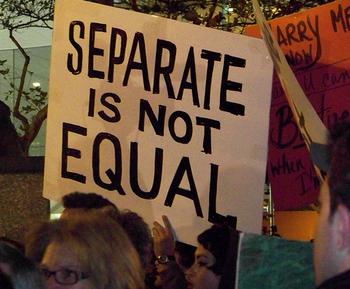
As the result, “ on May 17, 1954, the Court overturned Plessy v. Ferguson, and declared that racial segregation in public schools violated the Equal Protection clause of the 14th Amendment” (“Timeline of Events Leading to the Brown v. Board of Education Decision, 1954”). In Marshall’s speaking, he said that “racial segregation of children in public schools violated the Equal Protection Clause of the Fourteenth Amendment, which states that "no state shall make or enforce any law which shall ... deny to any person within its jurisdiction the equal protection of the laws” (McBride). Also, “ the Court concluded that racial segregation in school did not offer equal education to black children which was a promise, and although the public facilities were equal between black and white schools, racial segregation in school [was] ‘inherently unequal’and thus that was unconstitutional” (McBride)
“ On May 31th, 1955, the Supreme Court declared Brown II which was intended to work out the mechanics of desegregation, and made the desegregation in schools happen with ‘all deliberate speed’ in the whole United States” (“Timeline of Events Leading to the Brown v. Board of Education Decision, 1954”).
Brown v. Board of Education in Topeka was super meaningful for the desegregation of education in the United States, especially for black students. The decision might change their future.
Sources:
Dudley, Mark E. Brown v. Board of Education (1954): School Desegregation. New York: Twenty-First Century, 1994. Print.
"Brown v. Board of Education Timeline." National Archives and Records Administration. National Archives and Records Administration, n.d. Web. 29 Apr. 2014.
McBride, Alex. "Brown v. Board of Education (1954)." PBS. PBS, n.d. Web. 29 April. 2014.

No comments:
Post a Comment